
Nearsighted vs Farsighted: Causes, Symptoms, and Treatment Options



Your doctor just told you that you have nearsighted or farsighted vision. But what does that really mean? It’s a common question, and you are not alone. Over 150 million Americans have a refractive error, so if you’re trying to make sense of nearsighted vs farsighted vision, this mini lesson will clear up the confusion.

Shop These Zenni Glasses
How Our Eyes Work
First, let’s look into how our eyes work. For us to see clearly, light has to pass through multiple transparent focusing structures in our eyes (the cornea and the lens), then come to a focus point on the back of our eye (the retina). The cornea is a clear, dome-shaped tissue that sits at the front of your eyes and is responsible for about ⅔ of the refracting power, or bending power, of light. The lens is positioned right behind the iris, which can further focus light onto the back of your eye, and is responsible for about ⅓ of the refracting power. Finally, the retina is a layer of light-sensitive cells called photoreceptors located in the back of your eye. The retina absorbs the light and converts it into electrical signals. Those signals connect with the optic nerve to reach the brain, where they’re translated into the images we see.
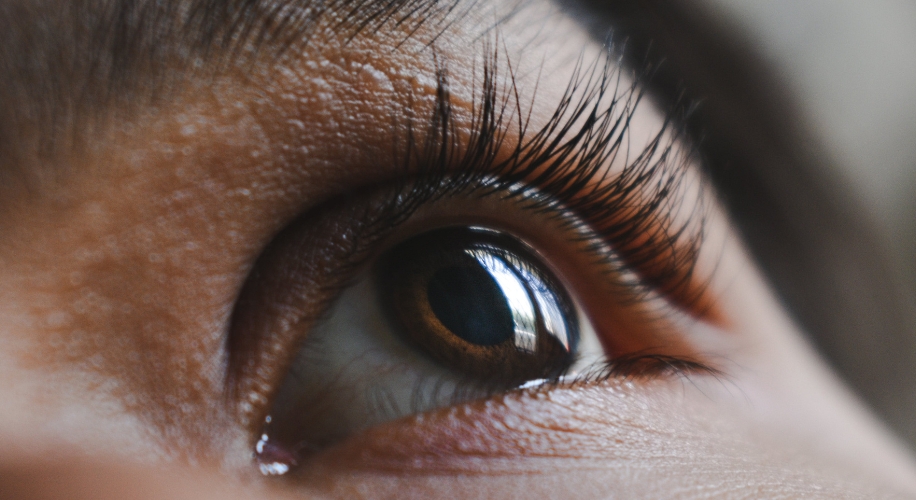
Photo by Kush Kaushik from Pexels
What Is Nearsighted Vision?
Nearsightedness, or myopia, is when your eyes are focused for near objects and have difficulty seeing distant objects.
Causes of Nearsightedness
It’s all about the shape of your eye. If your eyeball is too long compared to its focusing structures, light focuses just in front of the retina instead of directly on it. Genetics and lifestyle both play a role: if both parents have nearsightedness, a child is more likely to have it too, and how much close-up work we do versus time spent outdoors also matters, especially for children.
Symptoms of Nearsightedness
Here’s a quick list to help you understand how nearsighted people see:
- Blurry vision when looking at distant objects: If street signs or movie screens seem fuzzy, it’s time for a vision check.
- Needing to sit closer to the TV or at the front of the classroom: This is something to note if you have young children who can’t quite voice what blurriness yet.
- Squinting to see clearly: Often, this indicates that your eyes are straining, potentially due to uncorrected vision problems or exposure to bright light.
- Eyestrain or headaches: You may be a candidate for vision correction; a comprehensive eye exam can help determine this.
- Difficulty seeing at night: An eye examination will inform potential treatments for this condition.

Shop Zenni Mens Glasses
What Is Farsighted Vision?
Let’s shift our focus to farsightedness, also known as hyperopia. Farsightedness is the opposite of nearsightedness. Distant objects are typically clear, but close-up items seem a bit blurry or cause extra strain on your eye.
Causes of Farsightedness
So, why does farsightedness happen, and how does it differ from nearsightedness?
Unlike nearsightedness, the eyeball is too short compared to the refracting structures on your eye, causing light to focus behind the retina instead of on it. Just like nearsightedness, genetics can play a role in whether or not you have farsightedness. Many young patients have very strong lens muscles which can increase the focusing power in the lens to overcome their farsightedness. What this means is that they are always using their focusing muscles and this can lead to eyestrain or fatigue even though they can see clearly.
Symptoms of Farsightedness
Here is another list to help you understand how farsighted people see:
- Blurry vision for close tasks: Trouble reading or doing other close-up work is a classic sign.
- Eye strain or discomfort during close work: This could be a hint if your eyes feel tired or achy after reading or screen time.
- Headaches after your work day: Notice a pattern of headaches after spending time on detailed tasks? Your eyes might be working overtime to compensate.
- Crossed eyes in children: Farsightedness can sometimes lead to crossed eyes because they are overusing their focusing muscles.

Shop Zenni Womens Glasses
Diagnosing Nearsightedness and Farsightedness
Both conditions are diagnosed through a comprehensive eye exam, not just a basic screening. Your eye doctor may use a visual acuity test (reading letters on a chart), a refraction test (a phoropter measures your exact refractive error), and retinoscopy (a light shined into your eye to see how it reflects off the retina). Together, these determine whether you’re nearsighted, farsighted, or something else, and how strong your prescription needs to be.
Deciphering Your Prescription
So you’ve gone to see your eye doctor and they hand you a paper with many numbers and symbols on it. How do you figure out if you’re nearsighted or farsighted? It all comes from the Sphere section of your prescription, sometimes shortened to “SPH.”
Nearsighted prescriptions are denoted with a minus (-) sign, showing a need to diverge light rays for clearer distant vision. On the other hand, farsighted prescriptions have a plus (+) sign, signifying the need to converge light rays for better close-up vision. These numbers after the plus or minus sign measure the magnitude of correction needed to achieve a clear vision of objects near or far.
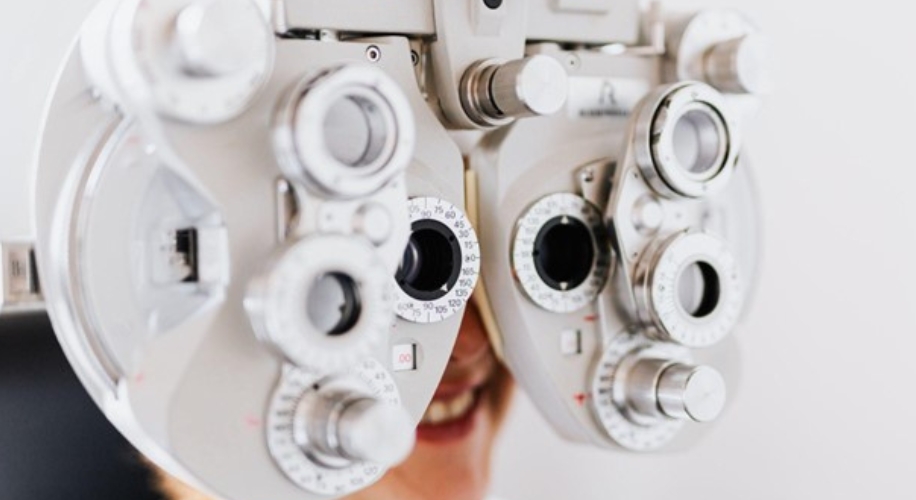
Photo by Karolina Grabowska
How to Treat Nearsighted and Farsighted Vision
Eyeglasses and contact lenses are the most common treatments, and refractive surgery is also an option for some patients. Nearsighted lenses redirect light rays to focus further back, directly on the retina instead of in front of it. Farsighted lenses do the opposite, helping light converge sooner so it lands on the retina instead of behind it. Zenni offers hundreds of affordable, high quality glasses suitable for both conditions, customizable to fit your lifestyle. Explore our collection of men’s glasses or women’s glasses now, and find your perfect pair today.
Nearsighted vs Farsighted vs Astigmatism vs Presbyopia
It’s easy to lump every blurry-vision condition together, but each is distinct. Astigmatism is an irregular curvature of the cornea or lens that creates two focus points instead of the single point that falls in front of (nearsightedness) or behind (farsightedness) the retina. Presbyopia is different still: an age-related loss of near focus starting around your 40s, even in people who were never nearsighted or farsighted. It’s possible to have more than one at once, which is why a prescription may correct for several together.
Childhood Vision Changes and Early Detection
Both conditions commonly develop or change during childhood, so regular eye exams for kids matter just as much as they do for adults. Many children are naturally a little farsighted and grow out of it, while others develop progressive nearsightedness with heavy near work like screens and reading. Since kids don’t always know how to describe blurry vision, catching changes early through routine exams helps ensure an accurate prescription throughout childhood.

About the Author: Dr. Catherine Ong
Dr. Catherine Ong, OD, is an optometrist based in the Bay Area, California. She earned her doctorate from UC Berkeley, School of Optometry and currently provides primary and speciality eyecare in a private practice setting. She has a passion for patient education and enjoys reshaping technical concepts into digestable topics for all patients. When she is not seeing patients, you can find her exploring new restaurants, exercising, or trying out new recipes.
FAQs
Which Is More Common, Nearsightedness or Farsightedness?
Myopia (nearsightedness) is more common, largely due to growing environmental factors like and increase in activities that require near focus.
Can Someone Be Both Nearsighted and Farsighted at the Same Time?
It’s rare but possible, when one eye is farsighted and the other is nearsighted, sometimes called antimetropia.
How Can I Tell From My Prescription If I’m Nearsighted or Farsighted?
Check the Sphere (SPH) section. A minus (-) sign means you’re nearsighted; a plus (+) sign means you’re farsighted.
Is Nearsightedness or Farsightedness the Same as Presbyopia?
No. Presbyopia is an age-related loss of near focus that typically starts around your 40s, even in people who were never nearsighted or farsighted.
What Tests Diagnose Nearsightedness or Farsightedness?
A comprehensive eye exam using a visual acuity test, a refraction test, and retinoscopy determines which condition you have and how strong your prescription needs to be. Browse Zenni Eyeglasses once you know your prescription.




 Canada