
Visual Acuity Explained: How the Snellen Chart Measures Your Eyesight



Visual acuity is the medical term for the sharpness and clarity of your vision, or how well you can distinguish fine details at a given distance. As an optometrist, one of the fundamental tools we use to assess visual acuity is the Snellen chart. This iconic eye chart, with its distinctive letters in progressively smaller sizes, serves as a benchmark for gauging how well a person can see at a specific distance. From there, we refine your visual acuity to help prescribe the best glasses to fit your vision needs.

Shop these Zenni Glasses
The 20/20 Standard: A Benchmark for Clarity
When we refer to 20/20 vision, we’re talking about a standard level of visual acuity. If a person has 20/20 vision, it means they can see at 20 feet what a person with normal vision can see at the same distance. It’s often considered the gold standard for clear eyesight. Outside the United States, visual acuity is often expressed as a decimal or in metric notation instead, so 20/20 is equivalent to 6/6 or 1.0. However, the Snellen chart goes beyond this common measure, offering a range of visual acuity assessments.
Sharper Than Average: 20/15 Vision
For those with 20/15 vision, the clarity is even more impressive. A person with 20/15 vision can see at 20 feet what a person with 20/20 vision can see at 15 feet. This level of visual acuity provides clearer, sharper vision than what’s typically considered normal. Even for those with eagle-sharp vision without glasses, I still recommend sunglasses or computer glasses to protect your eye health.

Shop These Zenni Frames
What Affects Your Visual Acuity
Visual acuity depends on more than your eye shape. Light travels through the cornea and lens, focuses on the retina, and the brain processes it, so a change anywhere along that path can affect how sharp your vision is.
Refractive errors are among the most common causes of reduced visual acuity. Myopia, or nearsightedness, occurs when light focuses in front of the retina. Hyperopia, or farsightedness, is the opposite. Astigmatism happens when the cornea or lens has an irregular curve, scattering light instead of focusing it at one point. Read more in our guide to astigmatism.
Visual acuity also tends to decline with age and can be affected by eye diseases such as cataracts, glaucoma, and macular degeneration, which is why regular exams matter at every stage of life. See our guide to the eye puff test to learn how elevated eye pressure can affect vision over time.
Visual acuity is also only one part of overall visual function. It doesn’t measure contrast sensitivity, peripheral vision, or depth perception, so two people with the same 20/20 result can still experience vision differently.
Navigating the Road with 20/40: Vision Requirements for Driving
The Snellen chart plays a crucial role in determining if an individual meets the visual requirements for driving. In many US states, a visual acuity of at least 20/40 is necessary for an unrestricted driver’s license. This means a person can see at 20 feet what someone with normal vision can see at 40 feet. It’s a safety measure to ensure drivers can clearly see road signs and potential hazards. Most road signs use fonts that people with 20/40 vision can read easily. Certain occupations, such as commercial driving, aviation, and law enforcement, may require even stricter standards. If you are unsure whether your vision meets driving requirements, we suggest scheduling a comprehensive eye exam with your local optometrist.

Photo by Adrien Olichon
Challenges in Clarity: Low Vision and Beyond with 20/200
On the flip side, the Snellen chart also helps assess low vision. When visual acuity falls below 20/200, the individual is considered to have low vision. This doesn’t imply complete blindness, but it does indicate significant visual challenges that can affect daily living. In these cases, alternative methods and tools are explored to improve the individual’s quality of life and meet their specific visual needs. A person is considered legally blind when their better-seeing eye is worse than 20/200, even with the best glasses.
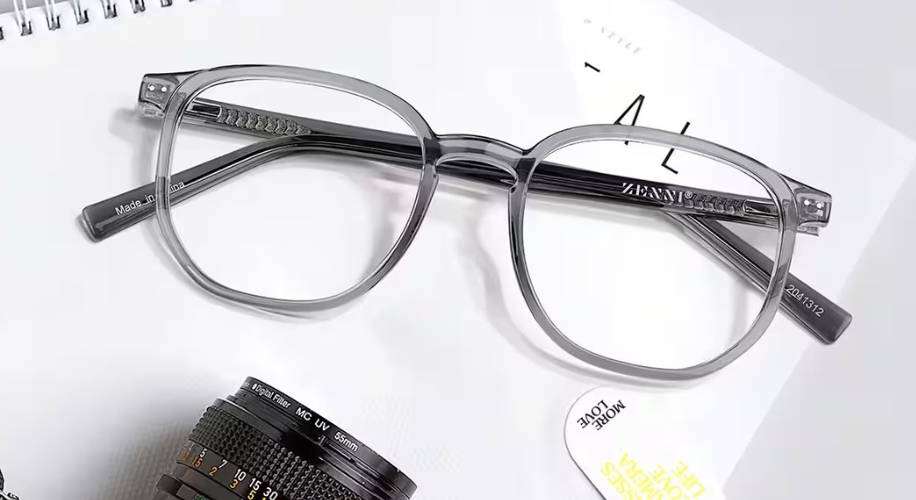
Shop These Zenni Frames
Beyond the Chart: Professional Eye Care
While the Snellen chart is a valuable tool, it’s only one part of a comprehensive eye exam. As an optometrist, I take the time to ensure you have the best visual clarity and comfort for your lifestyle, and that your ocular health is healthy from front to back. From checking for refractive errors to examining ocular structures, a thorough eye exam provides a holistic view of your eye health. Depending on the results, correction can range from prescription glasses to refractive surgery such as LASIK or PRK for a more permanent option.
After you see your local optometrist, browse Zenni’s extensive selection of frames to find the style that fits you perfectly. Personalize your glasses on our website to fit YOU, from selecting your frame shape and color to choosing the lens type and coating, all at an affordable price.

FAQs
What is visual acuity?
Visual acuity is the sharpness or clarity of your vision, typically measured as how well you can read letters on an eye chart from a set distance.
What does 20/20 vision mean?
20/20 vision means you can see at 20 feet what a person with normal visual acuity can see at that same distance. It is the benchmark for normal vision, not necessarily perfect vision.
What is considered legally blind?
A person is considered legally blind when their visual acuity in their better-seeing eye is worse than 20/200 even with correction such as glasses.
Can visual acuity change over time?
Yes. It can change due to refractive errors, aging, or eye conditions such as cataracts, glaucoma, or macular degeneration, which is why regular eye exams matter.
How is visual acuity corrected?
Most reduced visual acuity is corrected with prescription glasses. Some people also pursue refractive surgery such as LASIK or PRK for a longer-term option.




 Canada